Published: May 2026 | Category: American Life, Patriotism, Family
More Than a Holiday: What Memorial Day Really Means for American Families
Every year on the last Monday of May, something quietly profound happens across America. Flags are lowered to half-staff. Flowers are laid at graves. Families gather around backyard grills and picnic tables. Children wave small paper flags they barely know the meaning of – and grandparents sit nearby, eyes a little distant, carrying memories the children will one day inherit.
Memorial Day is many things at once. It is solemn and celebratory. It is personal and national. It is a pause – a rare, intentional pause – in the rushing current of American life to ask ourselves: Who made this possible? And just as importantly: How do we honor them?
This is not just a holiday. It is a mirror. And every year, it reflects back to us who we are, what we value, and what we owe.
The Roots of Remembrance: Where Memorial Day Began
The origins of Memorial Day stretch back to the aftermath of the Civil War – the bloodiest conflict in American history. By the time the guns fell silent in 1865, more than 620,000 soldiers from both the Union and the Confederacy had died. The country was shattered, but it was also searching – searching for a way to grieve, to heal, and to honor the fallen.
In communities across the country, people began holding informal ceremonies to decorate the graves of soldiers with flowers and flags. These gatherings were called Decoration Day, and they were acts of love as much as acts of mourning.
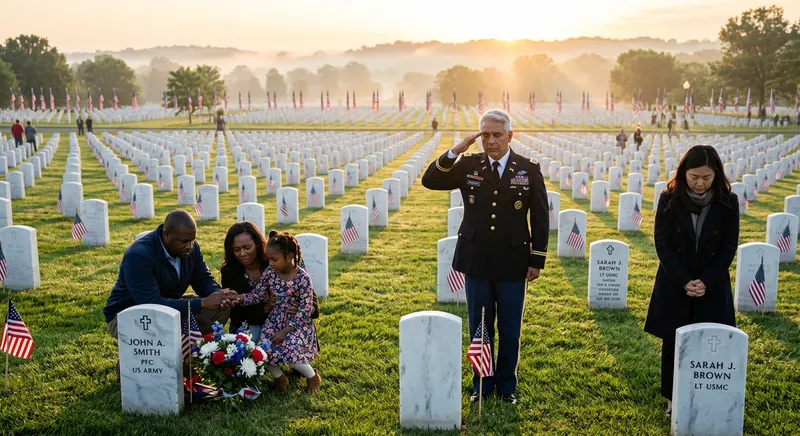
On May 5, 1868, General John A. Logan, commander of the Grand Army of the Republic, issued a proclamation designating May 30th as a national day to decorate the graves of fallen soldiers. He wrote:
“Let no neglect, no ravage of time, testify to the present or to the coming generations that we have forgotten as a people the cost of a free and undivided republic.”
Those words, spoken more than 150 years ago, are no less urgent today.
After World War I, the holiday expanded to honor American military personnel who died in all wars. In 1971, Congress officially declared Memorial Day a federal holiday, moved to the last Monday of May. But the heart of it – that original impulse to stop, to remember, to say thank you to those who gave everything – that has never changed.
What It Truly Represents: The Cost of Freedom
Diverse veterans of multiple ethnicities marching together in a Memorial Day parade down a small-town American Main Street
Freedom is one of those words Americans use so often it can start to feel weightless. We say it casually, almost reflexively. But Memorial Day has a way of restoring the full weight of the word.
Every freedom we enjoy – to speak our minds, to worship as we choose, to vote, to dream, to build lives of our own design – was purchased. And the currency was not money. It was the lives of men and women who were someone’s child, someone’s parent, someone’s best friend. People who had plans, and hopes, and whole futures ahead of them.
More than 1.3 million Americans have died in military service since the nation’s founding. That number is staggering. But it becomes even more powerful when you stop thinking of it as a statistic and start thinking of it as 1.3 million individual stories – each one a universe of love and sacrifice.
Memorial Day asks us to hold that weight. Not out of grief alone, but out of gratitude. Out of the conviction that a life offered in service to others is among the most extraordinary things a human being can do.
For American families – especially those with military members past or present – this holiday is deeply personal. It is about visiting a grave. It is about telling a child about a great-grandparent they never met. It is about sitting with the quiet knowledge that freedom has a face, and a name, and a story.
How American Families Celebrate: Tradition, Community, and Joy
A joyful multicultural Memorial Day backyard barbecue with African American, Hispanic, Asian, and Caucasian families celebrating together with patriotic red white and blue decorations
One of the most beautiful things about Memorial Day is how it holds space for both solemnity and celebration – and how American families have found their own ways to honor both.
🌿 Visiting Cemeteries and War Memorials
For many families, the day begins at a cemetery. Volunteers – often veterans, scouts, or civic groups – place small American flags at the graves of service members. Families bring flowers, photos, and stories. These are not sad pilgrimages. They are acts of connection – a way of saying, We remember. We are still here. You mattered.
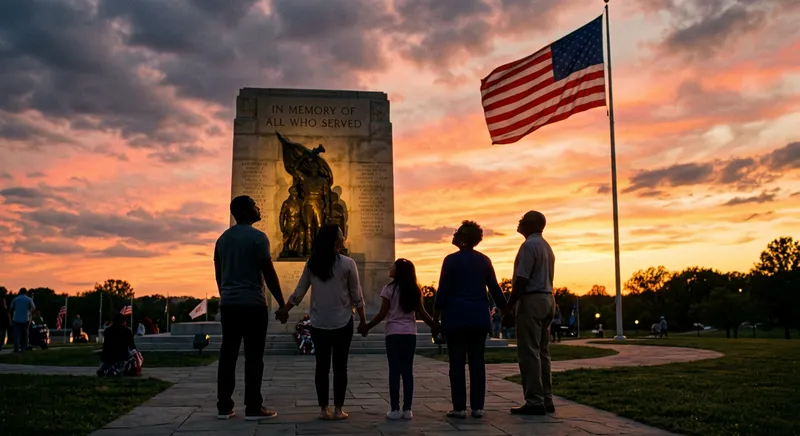
War memorials, from the Vietnam Veterans Memorial in Washington, D.C. to local monuments on courthouse lawns across the country, become gathering places. People trace names with their fingers. They leave tokens. They take pictures. They stand in silence and feel the full meaning of the day settle over them.
🎺 Parades and Community Ceremonies
There is something profoundly moving about a small-town Memorial Day parade. Veterans in their uniforms – some walking, some riding in convertibles – are cheered by neighbors who know them by name. High school marching bands play. Children line the curb, wide-eyed. The mayor says a few words at the town square.
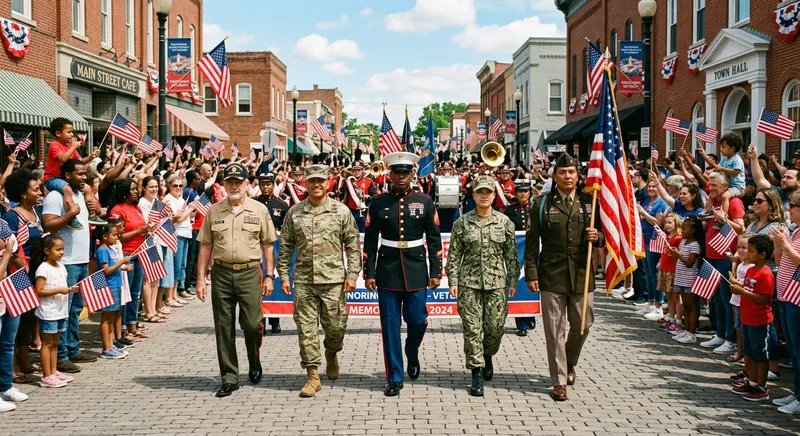
These parades are not performances. They are community rituals – shared expressions of gratitude and pride that stitch neighbors together and remind us that we are part of something larger than ourselves.
🇺🇸 The National Moment of Remembrance
At 3:00 PM local time on Memorial Day, Americans are invited to pause for a National Moment of Remembrance – one minute of silence to honor the fallen. It is a simple act. But in its simplicity lies tremendous power. Across every time zone, in cities and towns and living rooms and backyards, people stop. And for sixty seconds, the whole country holds its breath in honor.
🔥 Gathering Around the Grill
And yes – there are barbecues. There is potato salad and lemonade and corn on the cob. There are lawn games and kids running through sprinklers and dogs begging for scraps. There is laughter.
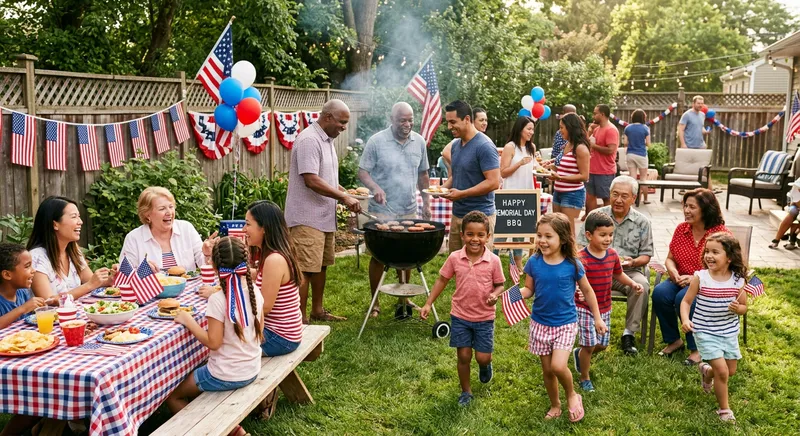
This too is a form of honoring the fallen. The soldiers who died did not fight for an abstract idea. They fought for this – for families gathered together, for the ordinary joy of a summer afternoon, for the right to live freely and fully. Celebrating life is not a contradiction of Memorial Day. It is, in many ways, the whole point.
Passing It Down: The Gift of Remembrance to the Next Generation
A diverse multicultural family – African American, Hispanic, and Asian members – silhouetted together at a war memorial monument against a brilliant sunset sky
Perhaps the most important thing we can do on Memorial Day is talk to our children.
Not in a way that is heavy or frightening – but in a way that is honest, age-appropriate, and rooted in love. Tell them about a relative who served. Show them a photograph. Explain, in simple words, that some people love their country and their neighbors so much that they are willing to give up everything to protect them.
Take them to a parade. Visit a memorial. Let them place a flag at a grave. These experiences leave a mark – not a mark of sadness, but of meaning. They teach children that history is not something that happened to other people in a faraway time. It is woven into the very ground they stand on.
When we give our children the gift of remembrance, we give them something that cannot be bought or downloaded: a sense of belonging to a story bigger than themselves. A sense of duty. A sense of gratitude.
And perhaps most importantly – a reason to live up to the sacrifice that was made for them.
Carrying the Flame Forward: What We Owe
General Logan’s words from 1868 still echo: Let no neglect testify that we have forgotten.
We have not forgotten. We must not forget.
But remembrance, at its best, is more than a feeling. It is a commitment. A commitment to build a country worthy of the people who died for it. To treat our neighbors with the dignity and respect that every American – regardless of background, belief, or circumstance – deserves. To engage in the ongoing, imperfect, extraordinary project of democracy with the seriousness it demands.
The men and women we honor on Memorial Day did not die for perfection. They died for the possibility of a more perfect union. They died believing that this country – flawed and striving and magnificent – was worth defending.
The least we can do is keep striving.
A Final Word: Let This Day Mean Something
This Memorial Day, wherever you are and however you choose to mark it – whether at a ceremony, a cookout, a cemetery, or quietly at home – let yourself feel the full weight and the full beauty of what this day represents.
Grieve the ones who were lost. Celebrate the freedom they gave us. Hug the veterans in your life. Tell your children the stories. Wave your flag with intention, not just habit.
And when 3:00 PM comes, stop. Close your eyes. Take a breath. And spend sixty seconds letting the gratitude wash over you – gratitude for the 1.3 million lives that made your life possible.
They gave everything. The very least we can give them is one minute, and a heart full of remembrance.
Happy Memorial Day. 🇺🇸
“The willingness of America’s veterans to sacrifice for our country has earned them our lasting gratitude.”
Share this post with someone who has a veteran in their family. And this Memorial Day, take a moment to thank someone who served – or to remember someone who gave all they had.